Last verified: October 18, 2026. Every figure in this guide was read at its source: ISTAT’s regional accounts, demographic indicators, tourism flows and language survey, the Senate’s text of the Constitution, ASTAT’s language count for South Tyrol, and SVIMEZ. I re-check the numbers every month.
The useful map of Italy has five blocks, not two, and not twenty equal squares. Most guides to the regions of Italy give you a list with a capital city and a famous dish. Most essays about the North and the South give you a mood. Neither tells you that the Centre-North produced 1.75 times the Mezzogiorno’s GDP per head in 2024, or that Rome sits in the Centre on every official map, or that Abruzzo counts as Southern (ISTAT, regional accounts 2022-2024, December 2025).
Disclosure: Some links in this guide may earn us a commission, at no extra cost to you. It never changes what we recommend.
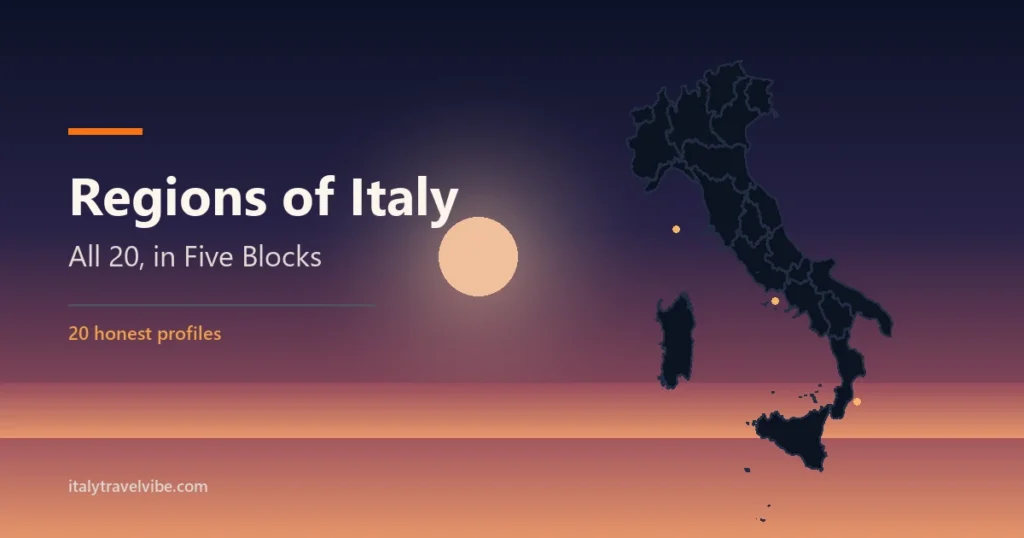
So this is the list and the argument together. All 20 regions, grouped the way ISTAT groups them, with the money, the visitors and the languages, then one pick per block. If you’ve ever wondered why Italian regional cultures feel so different from one train ride to the next, the numbers below are the honest answer.
Key Takeaways
- Italy has 20 regions, five with special statutes, and ISTAT groups them into five blocks, not two.
- In 2024 the Centre-North produced 1.75 times the Mezzogiorno’s GDP per head, and five regions took 58.6% of all overnight stays (ISTAT, 2025 and 2026).
- In Calabria, 64% of people still use dialect at home; in Sardinia, 73.3% know Sardinian (ISTAT, 2026).
- Pick one region per block and you’ll see three Italys in one trip.
Table of Contents
How Many Regions Does Italy Have, and Which Five Are Different?
Italy has 20 regions. Five of them have special statutes adopted as constitutional laws: Friuli-Venezia Giulia, Sardinia, Sicily, Trentino-Alto Adige/Südtirol and Valle d’Aosta (Constitution, article 116, Senate of the Republic). The Constitution of 1948 created the others, 14 at first and 15 once Molise split from Abruzzo in 1963, but they elected their first councils only on June 7, 1970, twenty-two years later (Senate dossier on the regions).
That delay matters more than it sounds. Sicily’s statute came first, in 1946, before the Republic itself. Friuli-Venezia Giulia’s arrived last of the five, in 1963, the same year Molise became the 20th region. So the map you see today is barely older than the people running it. Article 116 also says the Trentino-Alto Adige region “is made up of the autonomous provinces of Trento and Bolzano”, which is why ISTAT reports those two provinces separately and why I’ll do the same.
ISTAT sorts the 20 into five blocks, and I’ll use its groupings for the rest of this guide: North-west (4 regions), North-east (4), Centre (4), South (6) and Islands (2). When you read “Mezzogiorno” in an Italian newspaper, it means the South plus the two islands. Here is the whole country in one table.
| # | Region | Capital | Block (statute) | GDP per head 2024 | Nights 2024 | Foreign share |
|---|---|---|---|---|---|---|
| 1 | Piedmont (Piemonte) | Turin | North-west (ordinary) | EUR 38,600 | 14.4 M | 51% |
| 2 | Valle d’Aosta | Aosta | North-west (special) | EUR 47,700 | 3.7 M | 42% |
| 3 | Liguria | Genoa | North-west (ordinary) | EUR 39,100 | 16.1 M | 46% |
| 4 | Lombardy (Lombardia) | Milan | North-west (ordinary) | EUR 50,400 | 45.1 M | 65% |
| 5 | Trentino-Alto Adige/Südtirol | Trento | North-east (special, two autonomous provinces) | Bolzano EUR 61,600; Trento EUR 47,800 | 56.7 M | 62% |
| 6 | Veneto | Venice | North-east (ordinary) | EUR 41,500 | 73.5 M | 71% |
| 7 | Friuli-Venezia Giulia | Trieste | North-east (special) | EUR 39,000 | 10.1 M | 59% |
| 8 | Emilia-Romagna | Bologna | North-east (ordinary) | EUR 44,500 | 40.8 M | 30% |
| 9 | Tuscany (Toscana) | Florence | Centre (ordinary) | EUR 39,300 | 46.2 M | 58% |
| 10 | Umbria | Perugia | Centre (ordinary) | EUR 32,500 | 6.8 M | 35% |
| 11 | Marche | Ancona | Centre (ordinary) | EUR 34,100 | 10.5 M | 18% |
| 12 | Lazio | Rome | Centre (ordinary) | EUR 43,200 | 51.8 M | 67% |
| 13 | Abruzzo | L’Aquila | South (ordinary) | EUR 32,100 | 7.2 M | 15% |
| 14 | Molise | Campobasso | South (ordinary) | EUR 27,700 | 0.46 M | 9% |
| 15 | Campania | Naples | South (ordinary) | EUR 24,600 | 21.4 M | 54% |
| 16 | Puglia | Bari | South (ordinary) | EUR 24,300 | 17.9 M | 34% |
| 17 | Basilicata | Potenza | South (ordinary) | EUR 28,400 | 2.5 M | 18% |
| 18 | Calabria | Catanzaro | South (ordinary) | EUR 21,700 | 8.1 M | 20% |
| 19 | Sicily (Sicilia) | Palermo | Islands (special) | EUR 23,300 | 17.3 M | 50% |
| 20 | Sardinia (Sardegna) | Cagliari | Islands (special) | EUR 27,700 | 15.6 M | 51% |
GDP per head is ISTAT’s 2024 figure at current prices; seven of the 22 values are read from Eurostat’s copy of the same accounts, because ISTAT’s report names them only in a chart. Nights are ISTAT’s 2024 count of overnight stays in registered accommodation, with the share spent by visitors from abroad. Italy as a whole: EUR 37,300 per head, 466.2 million nights, 54.5% foreign. Why the map looks like this, with its kingdoms, duchies and a late unification, is a story for my Italian history guide.
Why Do the North and South Feel Like Different Countries?
Because the gap is real, measurable, and older than the country. In 2024, GDP per head was EUR 46,100 in the North-west and EUR 24,800 in the Mezzogiorno, and households in the South had EUR 17,800 a year to spend against EUR 27,100 in the North-west (ISTAT, Conti economici territoriali 2022-2024, December 2025). The ratio, 1.75 to one, barely moved from 2023.
The people are moving in different directions too. In 2025, ISTAT’s demographic indicators show the North growing by 2.2 residents per thousand while the Mezzogiorno lost 3.1 per thousand. Campania alone lost 17,000 people to other Italian regions in a single year, Sicily 11,000, Calabria and Puglia 7,000 each (ISTAT, Indicatori demografici 2025, March 2026). A man born in the North in 2025 can expect 82.3 years; in the Mezzogiorno, 80.8.
Then there is what you hear. In 2024, 68.8% of people in the North-west spoke mainly Italian at home, against 39.1% in the South and 39.9% on the islands (ISTAT, language survey 2024, January 2026). Money, people, language: three separate measurements, one shape.
One caveat, and I think it’s the important one. When Bocconi researchers put more than 1,000 Italians through trust and cooperation experiments, Southerners proved no less trusting or cooperative than anyone else; the one difference was a lower willingness to return a favor in proportion to its size (Bocconi University, origins of the gap, 2021). The authors argue the economic divide reflects decades of policy more than character. History and policy made the gap. People live inside it, and they’re not the gap.
How that shows up at the table, in the coffee rules and the dinner hour, is covered in my Italian culture guide. This guide is about the map and the money.
Where Does the South Begin?
On ISTAT’s map, the South starts at Abruzzo, and Rome is in the Centre. On the tourist map, it starts at Naples. Both are right, and the visitor numbers show the seam: in 2024, 67.2% of overnight stays in Lazio were spent by people from abroad, against 54.5% in Campania and 15.1% in Abruzzo (ISTAT, I flussi turistici 2024, March 2026).
Three lines are visible from a train window. The first is prices: household spending per head in 2024 was EUR 15,600 in Campania and EUR 31,200 in Valle d’Aosta, exactly double (ISTAT, December 2025). The second is trains: the high-speed network thins south of Salerno, which my guide to getting around Italy explains in detail. The third is language: in every Mezzogiorno region except Sardinia and Abruzzo, more than half of people use dialect at home, alone or mixed with Italian.
Sardinia is a block of its own, and it behaves like neither the South nor the North. In 2024, 73.3% of its residents knew Sardinian, a language protected by law and spoken nowhere else. About half of its visitors come from abroad. And in 2025 its fertility rate was 0.85 children per woman, the lowest in Italy for the sixth year running (ISTAT, March 2026). Treat it as the Islands block, which is what ISTAT does, not as the South with better beaches.
The five blocks side by side, then. ISTAT publishes some indicators only for the North, the Centre and the Mezzogiorno, so the South and the Islands share those cells.
| Block | Regions | Nights 2024 (share of Italy) | Foreign share | GDP per head 2024 | Population change 2025 | Life expectancy 2025, men / women |
|---|---|---|---|---|---|---|
| North-west | 4 | 79.4 M (17.0%) | 57% | EUR 46,100 | +2.2 per 1,000 (North) | 82.3 / 86.2 (North) |
| North-east | 4 | 181.1 M (38.8%) | 58% | EUR 43,600 | +2.2 per 1,000 (North) | 82.3 / 86.2 (North) |
| Centre | 4 | 115.2 M (24.7%) | 57% | EUR 40,000 | 0.0 per 1,000 | 82.1 / 86.0 |
| South | 6 | 57.6 M (12.3%) | 36% | EUR 24,800 (Mezzogiorno) | -3.1 per 1,000 (Mezzogiorno) | 80.8 / 84.9 (Mezzogiorno) |
| Islands | 2 | 33.0 M (7.1%) | 51% | EUR 24,800 (Mezzogiorno) | -3.1 per 1,000 (Mezzogiorno) | 80.8 / 84.9 (Mezzogiorno) |
Sources: ISTAT tourism flows 2024 (March 2026), regional accounts 2022-2024 (December 2025) and demographic indicators 2025 (March 2026).
What Does the Money Say? Regions of Italy by GDP per Head
The richest territory in Italy is the province of Bolzano, at EUR 61,600 per head in 2024, followed by Lombardy at EUR 50,400, Trento at EUR 47,800 and Valle d’Aosta at EUR 47,700. The poorest is Calabria at EUR 21,700, then Sicily at EUR 23,300 (ISTAT, Conti economici territoriali, December 2025). Italy as a whole sits at EUR 37,300.
What does that mean on the road? Less than the headline suggests, because tourist prices follow tourists, not residents. A coffee in Bolzano costs more than one in Messina, but a hotel on the Amalfi Coast in July costs more than one in Turin. The place the gap really shows is in the ordinary economy around you: the trattoria’s lunch menu, the bus fare, the price of a market lunch. My Italy trip cost guide has the budget by city, so I won’t repeat it here.
Now the turn in the story, because the gap is not a straight line down. In 2025, ISTAT’s preliminary estimate has the Mezzogiorno growing faster than the rest of the country: GDP up 0.6% against 0.5% elsewhere, and jobs up 1.5% against 0.8% in the North-east (ISTAT, Stima preliminare del Pil territoriale 2025, June 2026). Between 2021 and 2024 the South added almost 500,000 jobs, over a third of Italy’s total gain (SVIMEZ, Rapporto 2025, November 2025).
And yet the young still leave. In 2022 to 2024, 175,000 young Southerners moved to the Centre-North or abroad, 7,000 more than in 2017 to 2019. Half of the men and 70% of the women who go are graduates. Youth employment in 2024 was 77.7% in the Centre-North and 51.3% in the Mezzogiorno (SVIMEZ, November 2025). Both things are true at once: the South is growing, and it’s still emptying. You’ll feel it in Basilicata’s villages and in Bari’s new offices on the same day.
Which Regions of Italy Get the Tourists?
Five regions, Veneto, Trentino-Alto Adige, Lazio, Tuscany and Lombardy, took 273 million of Italy’s 466 million overnight stays in 2024, which is 58.6% of the total (ISTAT, I flussi turistici 2024, March 2026). The North-east alone took 38.8%. The South and the Islands together took 19.4%, with Molise at 0.1%.
The foreign share tells you who you’ll stand next to. Veneto’s visitors are 70.5% from abroad, Lazio’s 67.2%, Lombardy’s 64.8%. Emilia-Romagna, with 40.8 million nights, is only 29.9% foreign: it’s where Italians go on holiday, on the Riviera from Rimini to Cervia. Germans dominate the Alpine North-east and Sardinia; Americans and the French lead on the Southern coasts; Britons lead in Valle d’Aosta (ISTAT, March 2026).
The long view is the surprising part. In 1962, three quarters of all nights fell in seven Centre-North regions and the Mezzogiorno had just 11.7% (ISTAT, Storie di dati: Dal Grand Tour al turismo di massa, October 2026). By 2024 the South and Islands had 19.4%, and visitors from abroad, 33.6% of nights in 1990, were 55.3% in 2025.
Which places are worth those nights, and which to skip, is the job of my region-by-region guide to the best places to visit in Italy. For the swaps that dodge the crowds, Bologna for Florence, Lecce for Positano, see my underrated cities list. This guide ranks nothing; it only tells you where everyone else is.
Do All Italians Speak Italian? Dialects and the 12 Protected Languages
Yes, nearly all of them, and many speak something else as well. In 2024, Italian was the mother tongue of 89.2% of residents aged six and over, 42% used dialect in at least one setting, and 3.7 million people, 6.6% of the population, knew one of the 12 languages protected by law (ISTAT, language survey 2024, January 2026).
Those 12 are named in Law 482 of 1999: Albanian, Catalan, Germanic, Greek, Slovene, Croatian, French, Franco-Provençal, Friulian, Ladin, Occitan and Sardinian (Law 482/1999, article 2, Normattiva). Where you’ll hear them is very local, and the table gives the shares where ISTAT or ASTAT measured one.
| Protected language | Where you’ll hear it | Who knows it |
|---|---|---|
| Sardinian | Across Sardinia | 73.3% of Sardinians (ISTAT 2024) |
| Friulian | Friuli-Venezia Giulia, outside Trieste | 44.8% in the region (ISTAT 2024) |
| Germanic | South Tyrol, plus Walser and other Alpine villages in Valle d’Aosta, Piedmont, Veneto and Trentino | 68.61% of South Tyrol declared German in the 2024 count (ASTAT) |
| Ladin | Dolomite valleys of Bolzano, Trento and Belluno | 4.41% of South Tyrol (ASTAT 2024); 2.9% of Bolzano residents know it (ISTAT) |
| Franco-Provençal | Valle d’Aosta and the Piedmont valleys | 23.1% in Valle d’Aosta (ISTAT 2024) |
| French | Valle d’Aosta, co-official by statute | not measured separately |
| Occitan | Piedmont’s western valleys; Guardia Piemontese in Calabria | not measured separately |
| Slovene | Friuli-Venezia Giulia, around Trieste, Gorizia and Udine | 7.6% know Slovene or Croatian in the region (ISTAT 2024) |
| Croatian | Three villages in Molise | counted with Slovene above |
| Albanian (Arbëreshë) | Villages in Calabria, Sicily, Basilicata, Molise, Puglia, Campania and Abruzzo | not measured separately |
| Greek (Griko, Grecanico) | Salento in Puglia; the Aspromonte area of Calabria | not measured separately |
| Catalan | Alghero, Sardinia | not measured separately |
Dialect is the bigger story for a visitor, and it has a map. In 2024, 64% of people in Calabria used dialect at home, alone or mixed with Italian, then Sicily at 61.5% and Campania at 61%. The North is not immune: Veneto scored 55.3% and the province of Trento 54.5%, both above Marche’s 49.9%. Italy’s average was 38%, the Centre’s 26% and the North-west’s 22.2%. Tuscany (75.6%) and Liguria (75.5%) are where “mainly Italian at home” is most common.
Here’s the number that matters when you open your mouth: with strangers, 91.1% of people in the North-west and 87.4% in the Centre use Italian, and under 79% elsewhere. So a few words of Italian go further in Naples than in Milan. My basic Italian phrases guide has the 40 lines and the Southern “voi”; the manners behind them are in the culture guide.
What Is the North-West Like? Piedmont, Valle d’Aosta, Liguria and Lombardy (Regions 1 to 4)
The North-west is the richest block, at EUR 46,100 per head in 2024, and the one where Italian is most at home: 68.8% of people speak mainly Italian with their families (ISTAT, December 2025 and January 2026). Lombardy alone took 45.1 million nights in 2024, 64.8% of them foreign. The other three regions share one fact: each is cheaper and quieter than its reputation. My pick: Piedmont. Turin, the Langhe and the Alps, at prices Lombardy stopped charging years ago.
1. Piedmont (Piemonte)
Turin | North-west | Ordinary | EUR 38,600 per head | 14.4 M nights, 51% foreign
Piedmont feels French at the edges and industrial at the core. Its western valleys are where Occitan and Franco-Provençal still live under the 1999 law, and its capital built Italy’s car industry and seated the first parliament of the unified kingdom. Visitor numbers were flat in 2024, down 0.1%, which is the point: Turin gives you Milan’s museums and arcades with a fraction of the queues, as I argue in my underrated cities guide. The Langhe wine hills, Barolo and Barbaresco, are the best-value tasting region I compared.
2. Valle d’Aosta
Aosta | North-west | Special statute | EUR 47,700 per head | 3.7 M nights, 42% foreign
Italy’s smallest region is also one of its most distinct. French is co-official under its statute, 23.1% of residents know Franco-Provençal, and household spending per head, at EUR 31,200, was the highest in the country in 2024 (ISTAT). Visitors spent just 3.7 million nights here, about four in ten of them from abroad, with Britons the largest foreign group. Mont Blanc, the Gran Paradiso and the Roman theatre in Aosta are the draw; the ski season is in my skiing in Italy guide.
3. Liguria
Genoa | North-west | Ordinary | EUR 39,100 per head | 16.1 M nights, 46% foreign
Liguria is a 350-kilometer ribbon of coast with one big port in the middle. With Tuscany, this is where the most people speak mainly Italian at home, 75.5% in 2024 (ISTAT). Most visitors aim for the Cinque Terre and the Riviera; Genoa, with one of the largest medieval centers in Europe, is the base I’d choose instead, and I say why in the underrated cities guide. Nights were stable in 2024, up 0.3%.
4. Lombardy (Lombardia)
Milan | North-west | Ordinary | EUR 50,400 per head | 45.1 M nights, 65% foreign
Lombardy is Italy’s most populous region and its richest by GDP among the 20 (only the province of Bolzano scores higher). In 2024 its overnight stays grew 8%, to 45.1 million, and its population rose 3.2 per thousand in 2025, among the fastest in Italy (ISTAT). Milan is the engine, but most visitors come for the lakes: my Como vs Garda vs Maggiore comparison picks between them. Bergamo’s upper town is the night I’d add.
Why Is the North-East Italy’s Tourism Engine? Trentino-Alto Adige, Veneto, Friuli-Venezia Giulia and Emilia-Romagna (Regions 5 to 8)
The North-east is Italy’s tourism engine: 181.1 million nights in 2024, 38.8% of the national total, 58.1% of them foreign (ISTAT, March 2026). It holds two of the five special statutes, the richest territory in the country, and two of the places where dialect is strongest. No other block is so prosperous and so unlike the Italy of the postcards. My pick: Trentino-Alto Adige. Two languages, the Dolomites, and the longest lives in the country.
5. Trentino-Alto Adige/Südtirol
Trento | North-east | Special statute, two autonomous provinces | Bolzano EUR 61,600, Trento EUR 47,800 | 56.7 M nights, 62% foreign
This is the region where the powers sit with the two provinces, and it shows. In South Tyrol’s 2024 language count, 68.61% of residents declared themselves German-speaking, 26.98% Italian and 4.41% Ladin (Province of Bolzano, ASTAT count, December 2024). Bolzano is the richest territory in Italy, and the region had Italy’s longest lives in 2025, 82.8 years for men and 86.8 for women (ISTAT). South of the Salorno gap, Trento speaks Italian, and 54.5% of its people use dialect at home. The Dolomites straddle both: my Dolomites guide covers Cortina, Alta Badia and the post-Olympic lifts.
6. Veneto
Venice | North-east | Ordinary | EUR 41,500 per head | 73.5 M nights, 71% foreign
Veneto is the most visited region in Italy, with 73.5 million nights in 2024, and the most foreign, at 70.5% (ISTAT). By ISTAT’s count, dialect is also stronger here than anywhere else in the North: 55.3% of people use it at home. That combination is why Venice has an access fee and Verona a line outside Juliet’s house. My Venice guide has the fee dates; Padua and Verona are the quieter nights I’d pair with it.
7. Friuli-Venezia Giulia
Trieste | North-east | Special statute | EUR 39,000 per head | 10.1 M nights, 59% foreign
Friuli-Venezia Giulia is three cultures in one small region. In 2024, 44.8% of residents knew Friulian and 7.6% knew Slovene or Croatian, both protected languages (ISTAT). Trieste was Austria’s port until 1918 and still drinks its coffee that way. The region took 10.1 million nights, 59% from abroad, many of them Austrians crossing the border. Trieste is one of the twelve cities I’d choose over a third day in Venice.
8. Emilia-Romagna
Bologna | North-east | Ordinary | EUR 44,500 per head | 40.8 M nights, 30% foreign
Emilia-Romagna is where Italians go on holiday. Of its 40.8 million nights in 2024, only 29.9% were foreign, the lowest share of any big region, because the Rimini coast fills with Italian families every August (ISTAT). Its population grew 3.4 per thousand in 2025, second only to Trentino-Alto Adige. Bologna, Parma and Modena are the food reason: my Italian food guide explains why this is the one region where “Italian food” means one specific thing.
What Makes Central Italy the Oldest Block? Tuscany, Umbria, Marche and Lazio (Regions 9 to 12)
The Centre is the oldest block, with a mean age of 47.7 in 2026, and the one whose population stood still in 2025, at 0.0 per thousand (ISTAT, March 2026). Its GDP per head was EUR 40,000 in 2024. Its tourism splits in two: Lazio and Tuscany took 98 million nights between them, Umbria and Marche 17 million. My pick: Umbria. Tuscany’s hill towns with a third of the pressure, and Orvieto little more than an hour from Rome by train.
9. Tuscany (Toscana)
Florence | Centre | Ordinary | EUR 39,300 per head | 46.2 M nights, 58% foreign
Tuscany is where Italian was born as a written language, and it still speaks it most: 75.6% of residents used mainly Italian at home in 2024, the highest share in the country (ISTAT). Its 46.2 million nights barely grew in 2024, up 0.4%, which tells you Florence is full. My Florence guide handles the nominative tickets; my Tuscany itinerary takes you to Siena and the Val d’Orcia, where the growth isn’t.
10. Umbria
Perugia | Centre | Ordinary | EUR 32,500 per head | 6.8 M nights, 35% foreign
Umbria is the only region with neither a coastline nor an international border. Visitors spent 6.8 million nights here in 2024, up 5%, with 35% from abroad (ISTAT). Assisi, Orvieto, Spoleto and Perugia’s own hill of a center give you Tuscany’s shape at a third of the pressure. The regional economy is modest, at EUR 32,500 per head, and that is exactly what keeps the agriturismi and the trattorie priced for locals.
11. Marche
Ancona | Centre | Ordinary | EUR 34,100 per head | 10.5 M nights, 18% foreign
Marche is the Centre’s quiet one. Only 18.2% of its 10.5 million nights in 2024 were foreign, and the total fell 1.7% (ISTAT). Dialect runs above the national average here, the only Central region where it does: 49.9% of people use it at home, against 38% nationally. Urbino, the Conero coast and the Sibillini mountains reward anyone willing to drive. Few international visitors do, and the prices show it.
12. Lazio
Rome | Centre | Ordinary | EUR 43,200 per head | 51.8 M nights, 67% foreign
Lazio is the Centre on every map and the North by its tourism: 67.2% of its 51.8 million nights in 2024 were foreign, the second-highest share in Italy, and the total grew 13.2% in a single year (ISTAT). Lazio’s laws also reach your bill: the region bans the coperto, the cover charge every other region allows, a rule I unpack in my tipping in Italy guide. My Rome guide does the first visit; the rest of Lazio, from Viterbo to the Pontine islands, is where Romans go to escape it.
Why Does the South Draw Mostly Italians? Abruzzo, Molise, Campania, Puglia, Basilicata and Calabria (Regions 13 to 18)
The South took 57.6 million nights in 2024, 12.3% of Italy’s total, and most of them were Italian: the foreign share was 36% (ISTAT, March 2026). It holds the country’s poorest region and its fastest-shrinking one, and also the places where tourism grew fastest. In five of its six regions, every one but Abruzzo, more than half the people use dialect at home. My pick: Puglia. The Southern region whose visitor nights grew fastest in 2024, still two-thirds Italian on the beaches, with Matera an hour inland, just over the Basilicata border.
13. Abruzzo
L’Aquila | South | Ordinary | EUR 32,100 per head | 7.2 M nights, 15% foreign
Abruzzo is the South’s richest region, at EUR 32,100 per head in 2024, and statistically the first Southern region, however Central it feels on a map (ISTAT). It is one of only two Mezzogiorno regions where dialect at home drops below half, with Sardinia. Visitors are overwhelmingly Italian: 15.1% of its 7.2 million nights were foreign, though the total grew 5.5%. Three national parks, the Gran Sasso and a coast of trabocchi fishing platforms, almost without a foreign tour bus.
14. Molise
Campobasso | South | Ordinary | EUR 27,700 per head | 0.46 M nights, 9% foreign
Molise became the 20th region in 1963 and is the least visited: 456,000 nights in 2024, 9.3% of them foreign, and a fall of 7.8% on the year (ISTAT). Its population shrank 6.5 per thousand in 2025. Three villages here still speak Croatian under the 1999 law, and Arbëreshë Albanian survives in others. It is a region of hill towns, transhumance tracks and almost no one. It’s the quietest honest Italy you can reach by car.
15. Campania
Naples | South | Ordinary | EUR 24,600 per head | 21.4 M nights, 54% foreign
Campania is the South’s giant: 21.4 million nights in 2024, 54.5% foreign, the only Southern region where foreigners are the majority (ISTAT). It is also where the gap bites hardest. Household spending per head was EUR 15,600 in 2024, the lowest in Italy; 17,000 residents moved to other regions in 2025; and life expectancy, 80.1 years for men, is the shortest of any region. Dialect at home runs at 61%, and you’ll hear “voi” used politely to one person. My Naples guide is the base for Pompeii and the Amalfi Coast.
16. Puglia
Bari | South | Ordinary | EUR 24,300 per head | 17.9 M nights, 34% foreign
Puglia is the region the last five years were about. Nights grew 6.4% in 2024 to 17.9 million, still only a third foreign, so you’ll share the beaches with Italians (ISTAT). The money has not caught up: EUR 24,300 per head in 2024, and 7,000 net residents lost to other regions in 2025. Salento keeps a Greek-speaking pocket, the Griko villages, and there are Arbëreshë towns inland. My Puglia guide has the seven-day route and the trulli.
17. Basilicata
Potenza | South | Ordinary | EUR 28,400 per head | 2.5 M nights, 18% foreign
Basilicata is emptying faster than any region in Italy: 9 residents per thousand lost in 2025, with the most negative internal migration rate in the country at 5.5 per thousand (ISTAT, March 2026). Its 2.5 million nights in 2024 were 18% foreign, nearly all of them for Matera. Yet it is also where Italian at home grew most since 2015, up 14.9 points, as the young leave and the old adapt. Matera’s cave city is the one night I’d add to any Puglia trip.
18. Calabria
Catanzaro | South | Ordinary | EUR 21,700 per head | 8.1 M nights, 20% foreign
Calabria is Italy’s poorest region, at EUR 21,700 per head in 2024, and its most dialect-speaking: 64% of people use dialect at home, and only 31.1% speak mainly Italian there, the lowest share in the country (ISTAT). Calabria lost 3.8 residents per thousand to other regions in 2025. Arbëreshë villages, more than in any other region, and a Greek-speaking area in the Aspromonte survive in its hills. Of its 8.1 million nights, 80% were Italian. Tropea, the Sila forests and the bronzes of Riace are why I’d go.
What Are the Islands Like? Sicily and Sardinia (Regions 19 and 20)
Both islands have special statutes, both draw about half their visitors from abroad, and both grew fast in 2024: Sardinia’s nights rose 9.9%, Sicily’s 5.5% (ISTAT, March 2026). Together they took 33 million nights, 7.1% of Italy’s total. They are as different from each other as either is from the mainland. My pick: Sicily. Three thousand years of other people’s empires on one island, and the best-value food in Italy.
19. Sicily (Sicilia)
Palermo | Islands | Special statute | EUR 23,300 per head | 17.3 M nights, 50% foreign
Sicily’s statute came first, in 1946, and its parliament still calls itself an assembly. Sicily is Italy’s second-poorest region, at EUR 23,300 per head in 2024, and its second most dialect-speaking, at 61.5% at home (ISTAT). In 2025 it lost 11,000 residents to other regions. Of its 17.3 million nights in 2024, half were foreign, with Americans and the French leading. My Sicily itinerary settles the east-versus-west question; Etna’s wines are in the wine tasting guide.
20. Sardinia (Sardegna)
Cagliari | Islands | Special statute | EUR 27,700 per head | 15.6 M nights, 51% foreign
Sardinia is the region with its own language: 73.3% of residents knew Sardinian in 2024, and Alghero still speaks Catalan (ISTAT). Sardinia is richer than Sicily, at EUR 27,700 per head, and emptier every year, with the lowest fertility in Italy at 0.85 and a population falling 5.1 per thousand in 2025. Its 15.6 million nights grew 9.9% in 2024, the fastest of any region, with Germans the largest foreign group. In 2025 UNESCO added the domus de janas, its prehistoric rock-cut tombs, to the World Heritage list (UNESCO World Heritage Centre, Italy).
How Do You Use the Regions of Italy on a Trip?
The rule I use is one region per block, and never three from the same block. A first trip is usually North-east plus Centre: Venice, Florence, Rome. A second is Centre plus South or Islands: Rome, then Naples and Puglia, or Sicily. A third is North-west plus South: Turin and the Langhe, then Calabria or Basilicata. The pairing logic, and how to combine regions without spending the trip on a train, is in the best places to visit guide.
Regional law reaches your bill in ways most visitors never notice. Lazio bans the coperto. The city tax ladder changes at every regional border, as my tourist tax guide shows. Regional train fares and the ticket validation rules are set region by region. And ZTL enforcement is a municipal decision backed by national law, covered in my driving guide. The five special-statute regions also keep more of their own taxes, which is part of why Bolzano’s roads and Aosta’s lifts look the way they do.
One more line of context. In December 2024, Italy’s Constitutional Court let the 2024 law on “differentiated autonomy” stand while striking parts of it, and in 2025 and 2026 Lombardy, Veneto, Piedmont and Liguria signed preliminary agreements with the government to take on more powers (Camera dei deputati, Regioni e finanza regionale, July 2026). The map may be young, but it is still being drawn.
Regions of Italy: FAQ
How many regions does Italy have?
Twenty. Five have special statutes adopted as constitutional laws: Friuli-Venezia Giulia, Sardinia, Sicily, Trentino-Alto Adige/Südtirol and Valle d’Aosta (Constitution, article 116). The other 15 are ordinary regions that elected their first councils on June 7, 1970. ISTAT groups all 20 into five blocks: North-west, North-east, Centre, South and Islands.
What is the difference between northern Italy and southern Italy?
Money, people and language. In 2024 GDP per head was EUR 46,100 in the North-west and EUR 24,800 in the Mezzogiorno; in 2025 the North grew by 2.2 residents per thousand while the Mezzogiorno lost 3.1; and 68.8% of North-westerners speak mainly Italian at home against 39.1% of Southerners (ISTAT). Bocconi’s research finds the cause in policy, not character.
Is Rome in northern or southern Italy?
Neither. Lazio is in the Centre on every official map, with Tuscany, Umbria and Marche. By its visitors it looks Northern: 67.2% of Lazio’s 51.8 million overnight stays in 2024 were spent by people from abroad, the second-highest share in Italy after Veneto (ISTAT, March 2026). The statistical South begins one region further on, in Abruzzo.
Which of the regions of Italy is the most visited?
Veneto, with 73.5 million overnight stays in 2024, 70.5% of them by visitors from abroad (ISTAT, March 2026). Trentino-Alto Adige follows with 56.7 million, Lazio with 51.8 million, Tuscany with 46.2 million and Lombardy with 45.1 million. The least visited is Molise, with 456,000 nights in the whole year, fewer than Lazio records in four days.
What are Italian regional cultures, and do all Italians speak Italian?
Italian regional cultures are the local layer under the national one: a dialect, a protected language in some places, a kitchen and a pace. Nearly everyone speaks Italian; it is the mother tongue of 89.2% of residents. But 42% also use dialect in at least one setting, and 12 minority languages are protected by law, from Sardinian to Friulian (ISTAT, January 2026).
The Bottom Line
The regions of Italy are one country with five blocks and at least three speeds. Here’s the short version:
- Twenty regions, five special. The ordinary 15 are younger than most of their mayors; the first councils sat in 1970.
- The gap is real. The Centre-North produced 1.75 times the Mezzogiorno’s GDP per head in 2024, and the South is growing faster now while its graduates still leave.
- Five regions take 58.6% of the nights. Veneto, Trentino-Alto Adige, Lazio, Tuscany and Lombardy. Everywhere else is quieter than you think.
- Nearly everyone speaks Italian, and many speak more. Dialect at home runs from 22.2% in the North-west to 64% in Calabria; 12 languages are protected by law.
- One region per block. That’s the whole trip-planning rule.
The manners that go with the map are in my Italian culture guide. Where to go within each region is in my best places to visit in Italy guide, and what to eat there, region by region, is in my Italian food guide. The history that made the map, from the Greeks in Calabria to the Austrians in Trieste, is in my Italian history guide.